

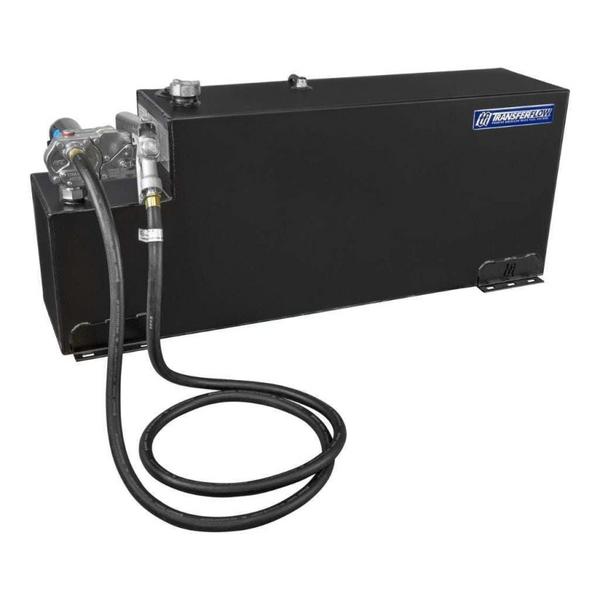
How much time have you lost leaving the job site to fill up gas cans for your work equipment? A truck bed transfer tank solves that problem by letting you carry fuel with you and deliver it to your equipment, from lawnmowers to tractors to excavators.
But there are some things you should know before you buy a fuel transfer tank. This guide covers what a transfer tank is and isn't, how to size it, which style and material to pick, and how to choose the right pump, hose, nozzle and accessories.
Prefer to watch? See the full video: What Is a Transfer Tank?
Transfer Tank vs. Auxiliary Fuel Tank: What's the Difference?
A transfer tank delivers fuel to other equipment; an auxiliary tank feeds your own truck.
They can look alike in a truck bed, but they do different jobs.
Purpose: A delivery vessel for refueling other equipment
Works with your vehicle's fuel system: No
Purpose: Extends your truck's run time between refuelings
Works with your vehicle's fuel system: Yes, in tandem with the existing system
For example, say you need to fill up a tractor. If you have fuel stored in your transfer tank, you can easily bring it to the tractor and refuel it in minutes.
How to Size a Transfer Tank for Your Truck Bed
Start with your truck model and its inside bed dimensions, then work around every obstacle in the bed.
- Measure the inside of the bed: Account for wheel wells, fifth wheel hitches, gooseneck hitches and bed covers.
- Do the tape test: Use painter's tape to outline the tank's footprint on the bed floor so you can see how much room it takes up.
- Add the mounting feet: Manufacturer dimension drawings don't always include mounting feet, so measure for them separately.
- Double-check the height: If you run a tonneau or bed cover, total height matters. Listed tank heights often leave out the pump, handles and fuel caps.
Choosing Transfer Tank Capacity
Transfer tanks range from about 20 gallons to 200 gallons. Pick a size based on what you're fueling:
Follow the 10% Rule
Most manufacturers recommend leaving the top 10% of the tank empty.
That headspace lets pressure regulate as temperatures swing during the day. Fill a tank to absolute capacity and fuel can push out through the rollover valve and into your truck bed.
Shop this section

The 4 Styles of Transfer Tanks
Transfer tanks come in four styles: L-shaped, vertical, split and tank/toolbox combos.
Pick the one that fits your bed layout and how you store tools.
What it is: Tank with a stepped profile that leaves room above
Best for: Truck owners who also want a crossover toolbox in the bed
What it is: Rectangular to nearly square, standing upright
Best for: Truck and service body owners who need to save bed space or fit exact measurements
What it is: Two internal compartments in one tank
Best for: Carrying two liquids, such as gasoline and diesel
What it is: Fuel tank and tool storage in one unit
Best for: Flatbed owners and anyone consolidating equipment storage
Weather Guard's newer L-shaped tanks are a popular pick for pairing a fuel tank with a crossover box.
Shop this section
 UWS85 Gallon L Shape Transfer Tank, White Steel (ST-85-L-W)14 gauge steel with a 2" NPT bung for adding a pump.
 Weather Guard110 Gallon White Steel L-Shape Transfer Tank (362-3-02)12-gauge steel, steel bed plate mount and a limited lifetime warranty.
 RDS90 Gallon Vertical Transfer Tank, Bright Aluminum 60x14x26 (73200)Aluminum vertical tank for diesel, gasoline or aviation fuel.
 Transfer Flow50/50 Gallon Split Fuel Transfer Dual-Tank System (0800113244)Two 50-gallon tanks, two pumps. Not for 2013–2024 Ram short beds with 5th Wheel Prep.
 Transfer Flow70 Gallon Fuel Transfer Tank Tool Box Combo (0800116230)Includes GPI pump, hose, nozzle and cab switch. Up to 8 GPM.
Steel vs. Aluminum Transfer Tanks (and Finish Options)
Choose steel for durability or aluminum for low weight and rust resistance.
Strengths: Harder to dent or puncture, longer service life
Choose it if: Your tank takes a beating on rough job sites
Strengths: Lightweight, rust resistant
Choose it if: You want to save payload or work in wet, corrosive conditions
Finishes
Common transfer tank finishes include gloss black, matte black, white, diamond plate and smooth. Finish isn't only about looks: a white protective finish, like the one on Weather Guard's steel transfer tank, helps deflect heat during the summer months.
Shop this section
 Transfer Flow82 Gallon Fuel Transfer Tank System (0800109420)12- and 14-gauge aluminized steel. 6-year, unlimited mile warranty.
 ATI51 Gallon Rectangle Transfer Tank, Black Aluminum (TTR51-B).125 diamond plate aluminum with welded mounting tabs.
 Weather Guard50 Gallon White Steel Transfer Tank (350-3-03)White finish, interior baffles and rubber isolation bushings.
Transfer Tank Pumps, Hoses and Nozzles
Match the pump's flow rate to your equipment and tank size, then pick a hose and nozzle that work with that pump.
How Transfer Pumps Are Powered
Clamp onto your vehicle's battery or an auxiliary battery each time you fuel. No installation, but an extra step every use.
Wired into your truck's electrical system once, then it's a simple flip of a switch.
Will a hardwired pump drain my truck battery? Not as long as the pump is switched off. Always follow the owner's manual so the pump is installed correctly.
Choosing Pump GPM
Pumps are rated in gallons per minute (GPM), measured at the pump, not the nozzle. Transfer tank pumps typically run from 8 to 25 GPM.
- Smaller equipment, such as mowers: a lower GPM is plenty. An 8 GPM pump flows about as fast as a gas station pump.
- Bigger equipment, such as excavators or tractors: step up to a higher GPM for faster fills.
Hose Length
Most transfer pumps ship with a 12-foot hose, and longer hoses such as 25 feet are available. Flow drops as hose length increases, so a longer hose calls for a higher-GPM pump to keep fill times reasonable.
Auto-Stop vs. Manual Nozzles
Compatible pumps: 8, 15 and 20 GPM
Notes: Pairs well with a flow meter
Compatible pumps: 15, 20 and 25 GPM
Notes: Shuts off automatically to reduce overfilling
We recommend an auto-stop nozzle whenever your pump supports it. Just remember it needs a pump rated at 15 GPM or higher.
Shop this section
 Fill-Rite8 GPM 12V DC Transfer Tank Pump with Nozzle (FR8)Gas-station speed for mowers and small equipment.
 Fill-Rite15 GPM 12V DC Transfer Tank Pump Kit, Auto Nozzle (FR1210HA)Auto-stop nozzle included. Meets the 15 GPM minimum.
 Fill-Rite20 GPM 12V DC Transfer Tank Pump Kit, Auto Nozzle (FR4210HB)Faster fills for big equipment or long hoses.
Transfer Tank Accessories Worth Considering
None of these are required, but each one pays off for the right kind of work.
What it does: Keeps dust and debris out of the fuel you dispense
Who needs it: Construction, forestry and other dusty job sites
What it does: Adds movement and flexibility, installed between hose and pump or hose and nozzle
Who needs it: Anyone fueling at awkward angles
What it does: Shows exactly how much fuel you've dispensed
Who needs it: Users with manual nozzles or tracking fuel by job
What it does: Lets you install a pump without spinning the whole unit 360°
Who needs it: Tanks with a pocketed pump setup, common on tank/toolbox combos
Spin collars are sold in kits with pumps and can't be bought separately, so check before you order.
Shop this section


Find the Right Transfer Tank at Elite Truck
Ready to stop hauling gas cans?
SHOP TRANSFER TANKSOr contact our team for help choosing the right tank, pump and accessories for your truck at 855-919-2087.
Transfer Tank FAQs
What is a transfer tank used for?
A transfer tank stores fuel in your truck bed so you can deliver it to other equipment, like mowers, tractors and excavators, without trips to the gas station.
Is a transfer tank the same as an auxiliary fuel tank?
No. An auxiliary tank connects to your truck's fuel system to extend its range. A transfer tank is a standalone delivery vessel with its own pump.
What size transfer tank do I need?
Transfer tanks range from about 20 to 200 gallons. A landscaping crew with a few mowers usually needs 20–50 gallons; heavy equipment like excavators typically calls for 100 gallons or more.
How full should I fill a transfer tank?
Leave the top 10% empty. The headspace lets pressure regulate as temperatures change and prevents fuel from leaking through the rollover valve.
Should I get a steel or aluminum transfer tank?
Steel resists dents and punctures and lasts longer. Aluminum is lighter and rust resistant.
What GPM transfer pump do I need?
Pumps range from 8 to 25 GPM. Use a lower GPM for small equipment and a higher GPM for large equipment or long hoses. Auto-stop nozzles require at least 15 GPM.
Will a transfer tank pump drain my battery?
A hardwired pump won't drain your battery as long as it's switched off and installed according to the owner's manual.